
In the heart of modern Hanoi, amidst bustling streets and towering high-rises, stands a somber relic of Vietnam’s turbulent past: the Hoa Lo Prison, originally known as Maison Centrale. Built by French colonialists in the late 19th century, this prison—whose Vietnamese name translates to “fiery furnace” or “hell’s hole”—served as a symbol of oppression, resistance, and resilience. Today, the preserved section functions as the Hoa Lo Prison Museum, offering visitors a poignant glimpse into Vietnam’s struggle for independence and the complexities of the Vietnam War.
The prison’s story spans over a century, reflecting layers of history from French Indochina to the American War (as it is known in Vietnam). What began as a tool of colonial repression became a site of revolutionary fervor and, later, the bearer of an ironic nickname during one of the 20th century’s most divisive conflicts.
The French Colonial Era: Building a Fortress of Fear
Construction of Maison Centrale began in 1896 on the site of Phu Khanh village, a former pottery and earthenware hub—hence the name “Hoa Lo,” meaning “stove” or “fiery furnace.” Completed around 1901, the prison was designed primarily to house Vietnamese political dissidents who were agitating against French colonial rule in Indochina. The French authorities euphemistically named it “Maison Centrale” or “Central House,” a term borrowed from the French prison system to denote a high-security facility, deliberately masking its brutal purpose.
The architecture was imposing and designed for maximum control. Thick walls reached up to four meters in height and half a meter in thickness, topped with electrified barbed wire and broken glass. Watchtowers stood at each corner for constant surveillance, and a wide patrol path encircled the interior. The heavy iron doors and locks were imported directly from France, underscoring the prison’s status as one of the most secure in Indochina. The main gate, still standing today, features a two-story arched entrance with the faded inscription “Maison Centrale” overhead.
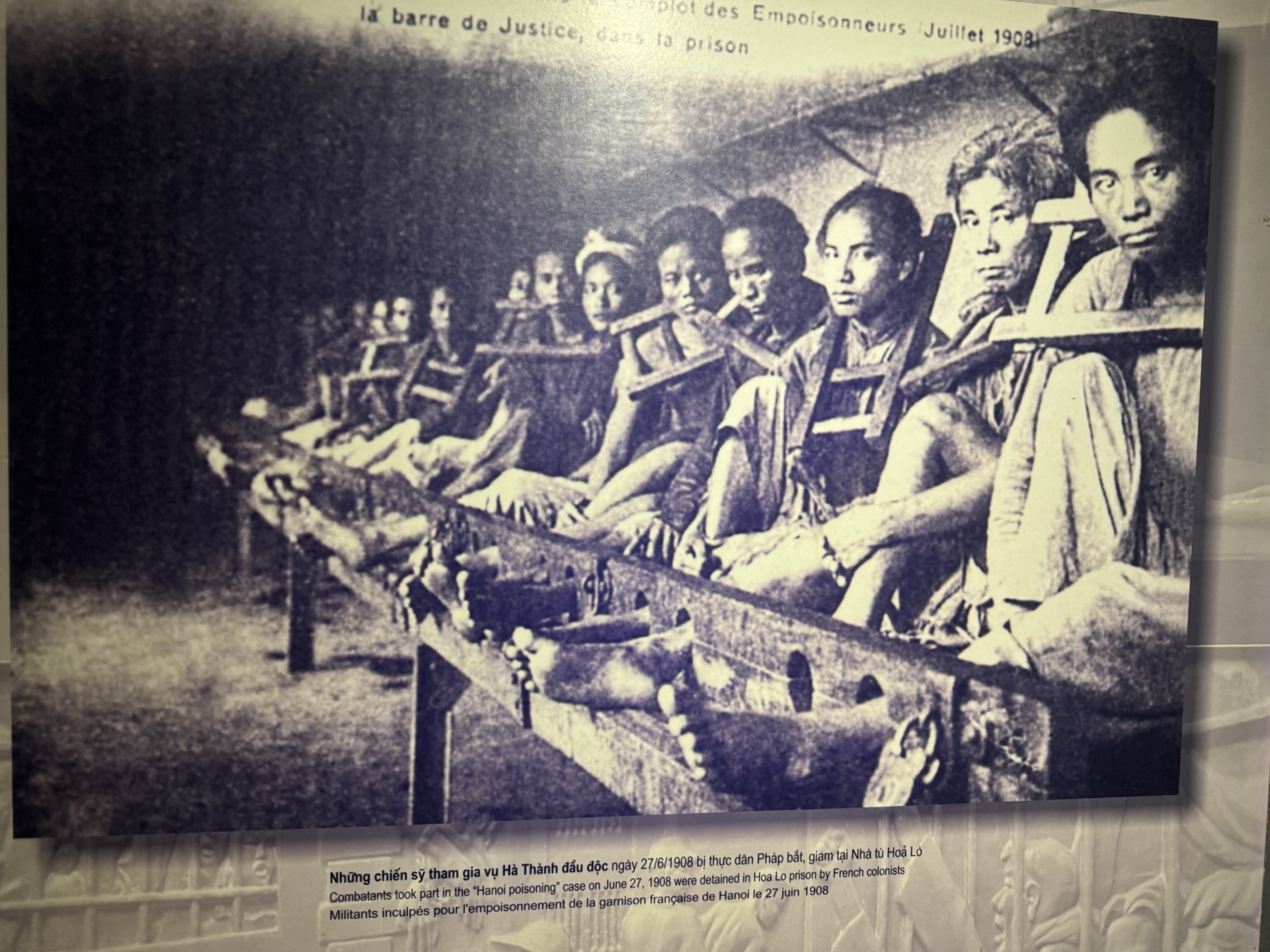
Originally intended to hold around 600 inmates, the prison quickly became severely overcrowded, accommodating up to 2,000 prisoners by the 1930s and 1940s. Conditions were deliberately inhumane: inmates were often shackled to the floor in large communal cells, forced into hard labor, and subjected to chronic malnutrition and rampant disease. Sanitation facilities were minimal, with prisoners given limited access to water or basic hygiene. Political prisoners, who formed the majority during the colonial period, faced systematic torture—whippings, early forms of waterboarding, electric shocks, and prolonged solitary confinement in pitch-black underground “cachots” or dungeons.
The guillotine became the most infamous instrument of terror. Imported from France, it was used for public executions meant to intimidate the population and crush resistance. Hundreds of Vietnamese patriots met their end beneath its blade, and one of the original guillotines remains on display in the museum today as a stark reminder of colonial brutality.
Despite the oppressive environment, Maison Centrale paradoxically became a crucible for Vietnamese revolutionary spirit. Many future leaders of the independence movement passed through its gates, including members of the Indochinese Communist Party. Prisoners secretly organized education sessions, sharing Marxist ideology, revolutionary literature, and plans for resistance. Ingenious escapes were planned and sometimes executed, such as the dramatic 1945 and 1951 breakouts involving tunnels dug through sewers or walls. These acts of defiance highlighted the prisoners’ extraordinary courage and determination.
Transition and the Vietnam War: The Birth of the “Hanoi Hilton”
Following France’s decisive defeat at Dien Bien Phu in 1954 and the subsequent Geneva Accords, Hanoi came under the control of the Democratic Republic of Vietnam (North Vietnam). Maison Centrale was repurposed, initially as a detention center for political opponents of the new regime and later for a very different group of captives.
As the Vietnam War escalated in the mid-1960s, the prison began housing downed American pilots and aircrew captured during bombing missions over North Vietnam. The first U.S. prisoner of war arrived in August 1964—Navy Lieutenant Junior Grade Everett Alvarez Jr.—and over the next nine years, nearly 600 American servicemen were detained at Hoa Lo, most of them Air Force or Navy aviators.
Conditions for these prisoners were harsh. They endured poor nutrition, unsanitary cells, prolonged isolation, and intense interrogation sessions. Many reported being subjected to torture, including the infamous “rope torture” where arms were bound tightly behind the back and hoisted upward, causing severe pain and sometimes permanent injury. Such treatment violated the Geneva Conventions, though North Vietnamese authorities maintained that the pilots were “war criminals” rather than legitimate prisoners of war.
It was the American inmates who gave the prison its sardonic Western nickname: the “Hanoi Hilton.” The ironic moniker contrasted the prison’s squalor and suffering with the luxury associated with the Hilton hotel chain, and it quickly entered popular culture through media coverage and later POW memoirs.
Among the most well-known prisoners were future U.S. Senator John McCain, shot down over Truc Bach Lake in Hanoi in October 1967 and held for more than five years, and Douglas “Pete” Peterson, who endured nearly seven years of captivity before becoming the first postwar U.S. ambassador to Vietnam in 1997. Other notable figures included James Stockdale, Everett Alvarez, and Jeremiah Denton.
The prison became a focal point in the propaganda war between the two sides. North Vietnam occasionally paraded prisoners before international journalists or allowed filmed interviews to demonstrate alleged humane treatment. Meanwhile, released POWs later recounted experiences of systematic abuse. Most American prisoners were repatriated in 1973 as part of Operation Homecoming following the Paris Peace Accords.
From Prison to Museum: Preservation and Controversy
By the early 1990s, rapid economic development and urbanization in Hanoi placed immense pressure on the aging prison complex. In 1993–1994, the majority of the site was demolished to make way for commercial high-rise developments, including what is now the Somerset Grand Hanoi serviced apartments and office towers.
Only the southern section and the iconic main gatehouse were preserved, thanks to efforts by historians and veterans’ groups. This remaining portion was transformed into the Hoa Lo Prison Museum, which opened to the public in 1997.
The museum’s exhibits are heavily weighted toward the French colonial period, vividly documenting the atrocities committed against Vietnamese revolutionaries. Visitors encounter original shackles, recreated cells with life-sized mannequins depicting emaciated and chained prisoners, replicas of escape tunnels, and the chilling guillotine room. These displays powerfully convey themes of colonial oppression and heroic Vietnamese resistance.
In contrast, the section devoted to the Vietnam War era is comparatively small and presents a distinctly North Vietnamese perspective. Photographs and captions emphasize the “lenient and humane treatment” of American pilots, showing them receiving medical care, celebrating holidays, or playing basketball. Personal artifacts such as John McCain’s flight suit are displayed alongside narratives that frame the pilots as aggressors who were nevertheless treated well.
This selective portrayal has drawn criticism from Western visitors and former POWs, who argue that it minimizes or glosses over the documented mistreatment many endured. Nonetheless, the museum’s approach aligns with its role in shaping national historical memory—celebrating the sacrifices made in the long struggle for independence while downplaying aspects that might complicate that narrative.
In recent years, the site has introduced more immersive experiences, such as evening “Sacred Night” tours that use dramatic lighting, sound effects, and live performances to evoke the atmosphere of imprisonment.
Visiting Maison Centrale Today: A Reflective Experience
The Hoa Lo Prison Museum is located at 1 Hoa Lo Street in the Hoan Kiem District of central Hanoi, just a short walk from Hoan Kiem Lake and the historic French Quarter. It is open daily from 8:00 AM to 5:00 PM, with a brief closure for lunch. As of early 2026, admission remains affordable, typically around 30,000 to 50,000 Vietnamese dong (roughly $1–2 USD), and multilingual audio guides are available for rent.
A thorough visit usually takes one to two hours. The atmosphere is understandably somber, and some exhibits—particularly those depicting torture and execution—are graphic and may be disturbing for sensitive visitors. The museum is wheelchair-accessible in parts, though some areas involve steps.
Maison Centrale, or Hoa Lo Prison, endures not merely as a historical site but as a profound testament to human endurance amid unimaginable hardship. It encapsulates the brutality of colonialism, the human cost of ideological conflict, and the possibility of eventual reconciliation—symbolized by figures like John McCain returning to Vietnam in later years as a gesture of healing.
In a city that seamlessly blends ancient temples with gleaming skyscrapers, this preserved fragment of a dark past invites reflection on the shadows of history and the unyielding light of resilience that ultimately prevailed.